Food · For SG & MY
Halal Food in Batam: A Guide for Muslim Travellers from SG and MY
Halal food is easy to find in Batam, but 'no pork, no lard' is not the same as certified. Here is how to read the labels and check for yourself.
By the BatamGems editorsUpdated 6 October 2026 4 min read
At a glance
- Indonesia's halal certificates are issued by BPJPH, the government halal agency.
- Businesses may use the old MUI halal logo until 17 October 2026; after that, the national label applies.
- You can check certification online at info.halal.go.id/cari/ or by scanning the label's QR code.
- Many Batam eateries use no pork or lard but are not halal-certified.
- Masjid Sultan Mahmud Riayat Syah, opened in 2019, has a 99-metre tower.
Halal food is widely available in Batam, from Malay and Indonesian eateries to mall food courts. The key distinction for Muslim travellers from Singapore and Malaysia is between certified halal, which carries Indonesia's official label, and "no pork, no lard", which is a restaurant's own description. This guide explains the labels and how to check them yourself.
Who certifies halal in Indonesia
Indonesia's halal certification is run by BPJPH (Badan Penyelenggara Jaminan Produk Halal), the government's Halal Product Assurance agency, which grew out of the Ministry of Religious Affairs. Before the switch, the halal label in use was the one issued by the Indonesian Ulema Council (MUI), and that old logo is still common.
The two logos you will see
The national halal label
BPJPH decree 40/2022 set a new national Halal Indonesia label to replace the MUI label, effective 1 March 2022, according to Halal Balancing. Products certified after that date carry the new label with a certificate number, and labels can carry a QR code you can scan to check validity.
The old MUI logo
Law firm SSEK reports that businesses still using the old logo may continue until 17 October 2026, after which they must use the national label on new production. Around the time of your trip you may therefore still see both.
How to check a certificate
- Scan the QR code on the halal label with your phone camera.
- Search online at info.halal.go.id/cari/, the tracing page BPJPH points to, by product or business name or certificate number. BPJPH's guide explains how.
- Ask to see the certificate at a restaurant. Certified businesses are expected to publicise their halal status.
"No pork, no lard" is not certification
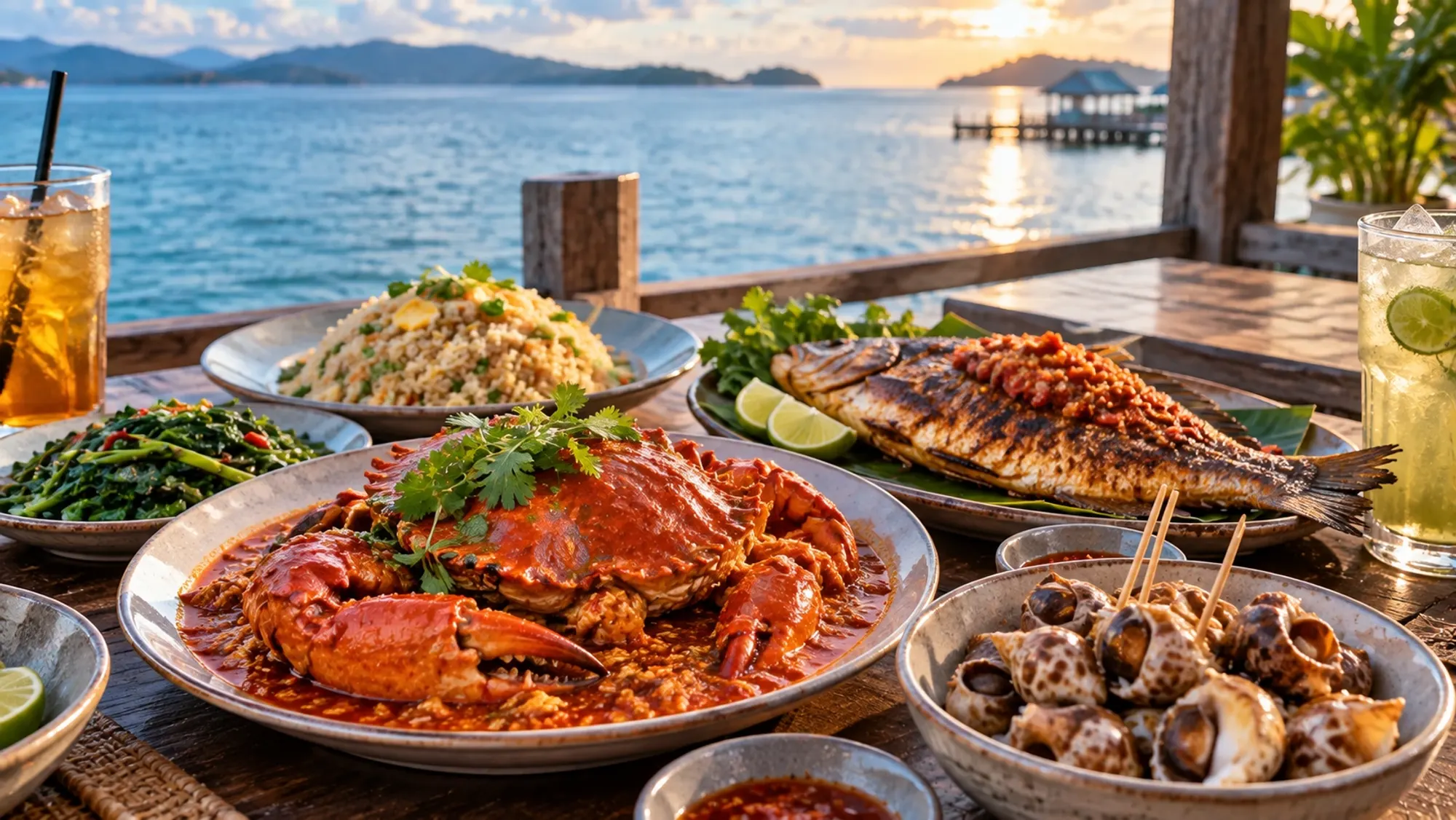
Many Batam restaurants, including popular seafood places, describe themselves as using no pork or lard. That tells you about ingredients, not about certification, alcohol on the premises or kitchen practices.
Eatbook's 2026 Batam food guide shows how common this is: most of its 20 listings are marked "not certified; no pork/lard used", a few serve pork, and only one, Piccola Stella in Batam Kota, is listed as halal-certified. Food courts such as Nagoya Hill Food Street vary stall by stall.
Decide your own standard before you travel, then check each place against it.
Practical tips for finding halal food
- Look for the label at the entrance or counter before you sit down.
- Malay and Indonesian eateries are the natural first choice; still check the label if certification matters to you.
- Mall food courts: check each stall.
- Seafood restaurants: ask whether they hold a certificate, and whether alcohol is served.
- Packaged snacks and souvenirs: look for the halal label and QR code on the pack.
- Hotels: ask whether the breakfast kitchen is certified.
Halal Batam dishes to look for
- Gonggong with sambal
- Mie tarempa with tuna
- Luti gendang, tuna-filled fried bread
- Sop ikan, clear fish soup
- Nasi lemak, Batam style
- Nasi dagong, rice with gonggong in banana leaf, found near the grand mosque in Batam Centre
Our what to eat in Batam guide has the full list. Always check certification at the specific stall or restaurant.
A quick checklist by situation
- Sit-down restaurant: look for the halal label or certificate at the entrance; if unsure, ask "Ada sertifikat halal?" (Do you have a halal certificate?)
- Seafood restaurant: ask about certification and alcohol, and check the condiments as well as the main dishes.
- Food court: check each stall separately; the mall's status does not cover every tenant.
- Bakeries and cake shops: check the label, especially for layer cakes and pastries you plan to take home.
- Supermarket and souvenirs: look for the halal label and QR code on the packet.
- Hotel breakfast: ask the hotel directly whether the kitchen is certified.
Halal snacks to take home
Bilis molen, kueh lapis and other packaged treats make good gifts. Check each pack for the halal label and its QR code, rather than relying on the shop's description.
Planning around prayer
Plan sightseeing so you can pray near a mosque or musholla. In Batam Centre the grand mosque is in the government precinct near the ferry terminal and malls; in Bengkong, the Cheng Ho mosque is in Golden City, the same area as The ILLusion. On a Barelang day, ask your driver where to stop.
Mosques worth knowing
Masjid Sultan Mahmud Riayat Syah
One of the largest mosques in Southeast Asia, according to Indonesia Travel. Opened on 20 September 2019, it has a 99-metre tower, a very large dome and umbrella canopies reminiscent of Masjid Nabawi.
Masjid Raya Batam (Batam Centre)
The city's grand mosque stands in the government precinct of Batam Centre, a short ride from the ferry terminal. The city has redesigned its exterior with Malay ornamentation.
Masjid Muhammad Cheng Ho
In the Golden City area of Bengkong, this mosque opened in 2015 and blends Chinese and Islamic design, with red walls and no conventional dome. It holds around 200 worshippers, according to Wikipedia).
For daily prayers on the go, ask at malls, hotels and the ferry terminal for the nearest musholla (prayer room).
Prayer times and time zone
Batam is on UTC+7, one hour behind Singapore and Malaysia. Set your prayer app to Batam or let it update automatically so prayer times match local time.
Visiting mosques respectfully
- Dress modestly; women may wish to bring a headscarf.
- Visit outside prayer times if you are sightseeing.
- Remove shoes where indicated.
Before you go
- Save info.halal.go.id/cari/ on your phone.
- Check your bank app can scan QRIS for easy payment: see money in Batam.
- Complete the All Indonesia arrival declaration: see entry requirements.
Questions people ask
Is Batam halal-friendly?+
Halal food is widely available, but many restaurants are 'no pork, no lard' rather than certified. Check for Indonesia's official halal label.
What does the Indonesian halal logo look like?+
The national Halal Indonesia label introduced by BPJPH in 2022, often with a QR code. The older MUI logo may still appear until 17 October 2026.
How do I check if a restaurant in Batam is halal-certified?+
Scan the QR code on the label or search info.halal.go.id/cari/ by name or certificate number.
What is the biggest mosque in Batam?+
Masjid Sultan Mahmud Riayat Syah, opened in 2019, with a 99-metre tower. It is one of the largest mosques in Southeast Asia.
Is there a Chinese-style mosque in Batam?+
Yes, Masjid Muhammad Cheng Ho in Bengkong, opened in 2015.
Sources we checked
- SSEK – Indonesia halal certification labelling rules
- Halal Balancing – Mandatory use of the BPJPH Indonesian halal logo
- Wikipedia – Halal Product Assurance Organizing Agency
- BPJPH – How to check halal certification status
- Eatbook – Batam food guide
- Indonesia Travel – Masjid Sultan Mahmud Riayat Syah
- Wikipedia (ID) – Masjid Sultan Mahmud Riayat Syah
- Batam City media centre – Masjid Raya Batam Centre
- Wikipedia – Cheng Ho Mosque (Batam)
- Indonesia Travel – Legendary Batam foods and where to eat them
- Wikipedia – Batam
- TheSmartLocal – Kid-friendly things to do in Batam
Rules, schedules and prices change. Check the official source before you travel.